On Turning Sixty, II: the day of detachment - where do stories begin? Where does motivation come from?
.jpeg)
(September, 2016)
...back to Twain's two important days, (birth and the day of discovering why you're here.) Expression and context. I'll here add a third, extend the cliche: The day you leave wherever you were, or the day of detachment. It's not the same as discovery though it goes in a similar direction. Not something inevitable but motivation - again that word - plays its part.
---------------------------------------------------------
I hurt my shoulder a couple months ago. Rotator cuff(s), good and torn. Likely at some point I'll need to get it operated on in order to return to, say, more than 85 percent functioning. Later. It's my right shoulder, the same rotator cuff(s) (a different one this time,) I detached about 36 years and one month earlier. Playing American football, high school, junior varsity. Third day of double sessions, hit the pad hard during a drill and...snap. (What the hell?)
I played through the season with the rip, likely making it worse, much. From time to time it would re-snap and the quick-crawling pain would shoot up then down. I'd let my arm dangle and head for the sidelines, get to the ground and writhe about for a minute or so, asking my body to pay attention to other inputs until the arm-crawl-pain eased. (Sophomores usually don't get much love in varsity play, all the more if they're...quiet. Something silly, maybe. One should learn to howl properly and keep howling, without so much intent. Most of the time, people do.)
In itself that wan't an important moment, then. It remained an unused memory until lately. But its temporal vicinity to another important moment makes it relevant to this...memoir? (Thesis? Essay? Story? Exercise in logorrheic-ness?)
A couple days after screwing my shoulder, during the intrasquad scrimmage, I was placed opposite my best friend and training partner at the time, Jim. Big Jim. Big boned blond, full chin, small brown eyes, giddy young smile and white skin. He was the second youngest on the team, I the first, and had the strongest upper body, I the second, in our grade. He played center, I defensive middle guard.
We were pre-ordained to be the anchors of the offensive and defensive lines in the years to come...except that such never happened. I was quicker than he, faster as well and had unusually strong lower body strength. Though a silly game still the route motion of 'besting' him wasn't hard- though it wasn't my intention. Play after play I stayed low and whipped through him, and others, making backfield tackles. I was gassed, hyped and like the games years earlier when I'd get the ball those few times and trudge down the field certain to score (- certain. Not of scoring, of course, but that 'all' of me was present, and certain of the knowledge of my relative strength. To get me down was difficult -) I was certain I could pass through anyone, even 2 or 3, on the field to get to the ball carrier, running back or QB, didn't matter. It's what I was supposed to do. So it went.
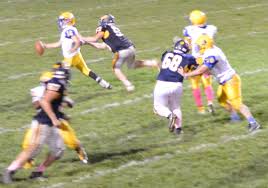
Until at some point... Jim tried to hold me a couple times, grabbing my jersey, to no avail. But on one play he must have grabbed on hard enough that the motion and force of my body pulled him off balance. He fell, his leg below my forward-moving right foot. I don't know whether it was the foot or his fall but... I felt it. The something-not-right beneath, stopped in the middle of the play, stopped and turned to look. And saw Jim lying on the ground, beginning to howl behind his face mask, grimacing horribly as he reached for his left knee. Whistles, play stop, attending trainee to him, the rest of us moving away to keep the scrimmage going some yards over to the right, 'part of the game', the coach cried, part of the game. I'd blown up his knee. My best friend.
I was on the field for only a couple more plays before the next kid got his chance. My confusion was likely discernible. It felt..awful, and stupid. No game was worth that. Still, it wasn't the look on Jim's face, the unstiffled howl, the moment of detachment. That came a few hours later... and had to do with refusal.
Backtrack. This is an autobiography of sorts, and the second in a series. Why did I skip over so many years, as if the above moment of detachment came from someplace..... automatic, from nowhere or no where? It's a question I'm asking myself right now, as I write these lines. Possible answers are many layered. And came in the first note: all of those possibilities had already happened. So why and where do you create the story?
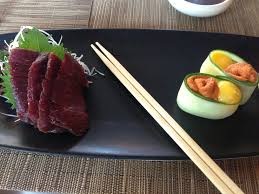
(whale sushi)
Return to Ahab, his whale, the context, the attachment. Could the story have gone another way? Ahab, his whale, the ship-the crew-the directions taken, chance, a sneeze, a slip, a love affair gone well, a felt brother or sister, a dog, a bad piece of meat, a warm wind, a storm. Any can change the course of a ship or the people leading it or on it. Moby sushi. But non of those happened, really, or did they?
Did it go another way after all, the story? Does it now? And where is the story, in words and flow of language, in the way we take in and infer the characters - when did you read it, Moby Dick, the abridged version (it's usually, or was, required reading a bit early, so to speak,) as you read or after the reading, from a movie version, from a spoken summary, from bits and other bits of related experience you fold in, Moby Dick, small representations from documentaries, from writers talking about the novel in various ways: all the wooden boats you've seen in magazines, on-line, in person, in movies, every one of those tiny things like a stone dropped or skipped in a slowly moving river, or fast, or still, the ripples interacting and reaching out so circular at first then mixing up their patterns until the design is so complex you don't really know anymore where one wave, one shape, came from. Still you try, always, to complete enough meaning to make an image, a topology of the whole, if you can. It always had to fit. And the whole thing brings up a word - motivation - and the word itself seems to bring itself back to center. Where does motivation come from? How does it develop? How many strata might there be before you actually not say but do - this?
Let me stick to the thing, mostly, being described here. That would be the author, me, in some way. How he developed.
My household, my family, was very loosely connected to distant relatives at first but then became utterly isolated. It was comprised of 4 people including me (and one dog.) The 3 other people each had significant... problems, which, alone, might have been at least mitigated but placed together, well... a 3 times catalyst. My mother would be diagnosable as psychotic in the DSM, the book from the US that categorizes mental disorders (though you could call it.... Doing Serious Money,) paranoid delusional, stress modulated. Words, those are. Conceptually it might be easier to consider her and similar untreated people as being, or development becoming altered significantly from any normality, at about 12 years of age or so. That is, imagine a relatively smart 12 year old girl living in an adult's body, under stress... not actually able to distinguish where.... her narratives, the story she and we all tell ourselves to make sense of things, come from, wether the data was created, from within or from without. Reality it's often termed vs. crazy, problems of hippocamp-al (a small thingy in your brain that's awfully important,) placement. Time travel, so to speak, or hormonal responses - can be very large for anyone without such or other problems but on her, that sort of influence is, well, often determinate of subsequent behaviors.
Maybe utterly so in defining her relation with my elder brother, the second familial element, whose entire life is basically... himself, or symbolic representations of himself. Think Donald Trump - the similarities in their behavior and even gestures and expressions is... unnerving. We call it psychopathy or psychopathic narcissism. Remorseless, criminal, a deep need to manipulate others until, wherever the scene might be, he can dominate. (pause. Here, I confirm why I thought I jumped over so many years: it's rather hard to write about 'then'. I get a tug on my hands, arms and throat, a pervasive bitterness and approaching panic. There are things that I didn't feel back then, at all really - because I was developed in such a way not to. But the thing about such mad, self-referring systems as my brother: they don't end. Ahab will chase his whale to the bottom of and again through the oceans. So consequences, if one doesn't leave the story in time, are often...tragic.) There are a host of changes that take place whenever we meet someone and don't turn away, your group, your lover, your friend. Literally your minds sync up. Those sorts of changes are much more pronounced, usually, with your children, in mothers all the more. Oxytocin (or oxytoxin, yukyuk,) and such: what you are, what you must do, what the world is, changes as does your place in it. My mother tied herself to her first born child in way a religious fanatic ties himself to his God. Something between a bible tale and a Hitchcock movie.
link - The Plasticity of Human Maternal Brain: Longitudinal Changes in Brain Anatomy During the Early Postpartum Period link to paper
And that dynamic made the already utterly, again, mad relation between my father and mother even more problematic. Because though she had trouble keeping reality in her mind, my father was more literally a bit out of his own. That is, unbeknownst to him - wether due to ignorance or caution (some stones, his also doctor brothers that took care of him after the car accident as he lay in the hospital bed during a month long coma, might be better left unturned. He was 25, not long after his graduation/specialization in cardiology. Four had been in the car - the other 3 died. I think my father had been driving. Drunk. He never regained the memories of that night,) derived from growing up in real poverty: my father had lost the majority of his left pre-frontal cortex, the part of your brain inside, a little past your ear going forward.
All your brain is always talking to all, or most of, the rest of itself and beyond. Stuff like behavior, observable and under the surface, emerge more than are decided upon. Like a giant chat room but with a hierarchy and with a resulting symphony, the partitures, (individual sections in music,) that emerge. In most of us, little chunks specialize in schematic ways. Very broadly, the left part up front can be very important for a bunch of things from updating information into new models of what you're supposed to do to controlling impulses often emotively influenced from other parts of the brain, to hearing, so to speak, and deciding which of the symphonic-mind partitures will be louder in the emergent symphony that is you. And other stuff. In a phrase: he was more than a bit fucked up and likely it was only his big intellect, the breath of the connections in other, un-damaged parts of his brain, that allowed him to function well enough, quickly enough, to appear, most of the time, mostly normal, at least functional.
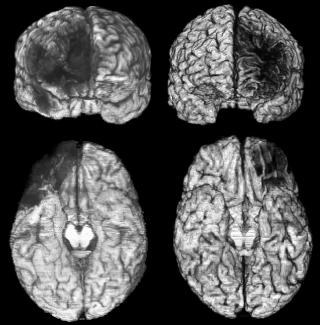
Exhale. Even writing those words is troublesome, emotive (as mentioned, emotions can be described as a way to allow systems to time travel, I think.) Anyway, from here there likely isn't a need to mention any of the too many specifics, the relative violence, intimidation, trauma, all that yelling and slapping and some hitting and the treachery and the things thrown and broken, the indifference, the manipulation - good if anyone reading has no idea of that sort of circumstance, sorriness for those who do. In that context it isn't so much a learning, the colloquial word, that counts as how motivation is developed, to be and express yourself, the way those dopaminergic, (the little soldier-molecules heavily used in reward and anticipation, joy a little and pleasure even more,) pathways feed into developing chunks of your brain and mind that are specializing.
In my case, the best way to be was to, well, mostly to not 'do', as in command but it's more than that in most social circumstances. Not, however, in the creating of delight, of pleasant surprise - that was always a kick. But public acknowledgement, unavoidable attention, more so praise than rebuke... from rather early gained, for me, a bitter flavor. Doing - but without being present, without being there. Always someplace else. Or, maybe a better phrase: I became motivated to socially avoid self-acknowledgment.
That separation... never came, that stable expression of one me from me. In such a house you fill in the necessary vacant places like replacing some pilllars holding a house. It usually happens to or used to happen more to daughters than sons: Peace-keeper, diplomat, friend, whatever was necessary to my family. But no self-involvement. So outside groups remained... things to not be intimately part of. Only that family to which not I belonged but had developed reward and inferred self-identity such that it was the only avenue through which any social elements of 'I' could be nearly fully expressed. The doing of things.
-----------------------------------------
So. Let's re-connect here to the narrative left behind a bit above. JV football, 14 years old. When Jim's knee caved in beneath my foot... it hurt me a lot. But the separation, that moment, came that afternoon - not hearing Jim's howl. After lunch, the 60 or so of us line-men sitting in a too warm room while a coach berated the whole of us for having been so scarce that day. I was sitting waaaaay in back, scrunched small and hunched over a desk. At the end of the coaches diatribe, he shouted out 'where's Gi-o-vanni?'
Not much looking by the bigger kids ahead of me in the room but a few turned their heads this way and that, seeing me huddled alone, almost disappeared. 'Gi-o, I hear you did a fine job.' With emphasis. His words fell upon me like... melted tar. Fine for ruining Jim's athletic career. From already halfway gone... away I left. The room, the group, the team, football even though I was still sitting hunched away, then hunched, if it were possible, even more, the emotions which others would take with something like delight doing for me the opposite: run. Do not accept any expression, social, of 'you'. Detachment.
Dopamine and Oxytocin Interactions Underlying Behaviors: Potential Contributions to Behavioral Disorders - link
Much of the above is of a summary kind - there is so much complexity in any element you choose, any subject. Network development, the way the roads in our brains change, adding more lanes, loosing them, adding off-ramps and on ramps and even paving new roads. At 14 we've just begun to hone in, socially, usually anyway, and all that requires a lot of inhibition: we have to fit in to the 'n' of whatever social system we find ourselves.
Some of those subjects will be be specifically modeled in the seasons and years, if I'm still around, to come, mostly in academic settings but not only. But I wanted to get to that notion of separation - because, as mentioned in the first post and here, the 'n' of a system remains n: until it doesn't. Then, things can change and often do, rapidly really, like a river overflowing at first it doesn't seem like a thing so huge, unstoppable. A few moments later though and you can see the tide swiping through, necessitating accommodation of anything in its path. Like birth, a bit, only we've already established a narrative subject, self. Which self that can and will then emerge - changes. Will whales be so necessary? The day you're born. The day you detach. The day you discover. Yaddayadda.

Change... it did, pretty rapidly and completely. Not such unusual stuff, at that age: God, existence, nothingness, the beginning of experiments, ecc. But not quite so frequent either. That chunk, the juiciest, for the next note already loosing its way.